Pieces of Eight

Pirate Battles on the High Seas!

Adventure and glory await you in Pieces of Eight, the rousing combat game of rival buccaneer ships on the high seas. You play the game with a stack of metal pirate coins held in one hand that represents your ship. The coins you choose and the order in which you place them determine your ship's strengths, and you use the special abilities of your coins to destroy your opponent's coins one by one. Your goal is to expose the Captain coin buried deep in the middle of your adversary's ship, then take him out!

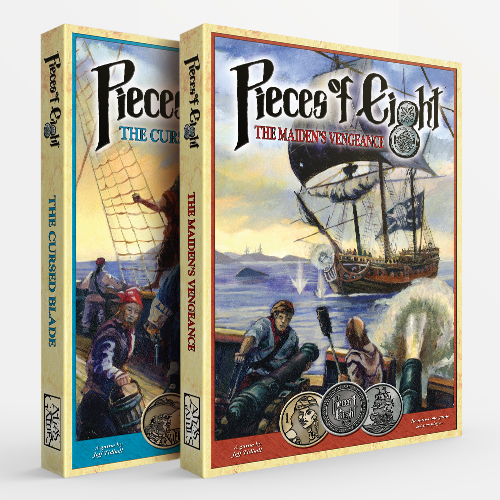
Dare to enter the age of blood and gold with either The Blade or The Maiden's Vengeance ship set. Each set includes all the coins needed for one player to construct his own ship. Your opponents will each need their own ship set to play, but there's no other limit to the number of players who can join in. The coins in each set are not randomized; you can combine ship sets to gain a wider selection of coins and the advantage over your foes.

2+ players (each with own set) - 10 to 30 minutes - ages 10 and up


Download the web banner for your own site!


Download the web banner for your own site!

Special Edition Summer Convention Coin!

To kick off the release of Pieces of Eight, Atlas Games gave away 20,000 copies of a special edition promotional Captain coin for Pieces of Eight! This unique gold-colored coin was available at Origins, GenCon, DragonCon, and other select venues. The promo Captain allows you to stretch your coins to include a 5th player if you own 4 ship sets. Just pool the 3 extra coins in each set, then add the promo Captain as the missing 13th coin!


Fist Full o' Gold:
An Interview with Artist Jeff Menges


We recently had a chance to ask Jeff Menges -- the artist behind Pieces of Eight -- a few questions about the project. Here's the full text of that interview, complete and unabridged ...

Q: How did you get involved in the Pieces of Eight project?

A: When most jobs come in that require line art, it's usually a matter of how big the space to fill is and which pen to use. This job was a bit different from the get-go.

My history with Atlas goes back a long way, mostly through Ars Magica, so when they asked to see samples relating to pirates, I was a little surprised. I know now that the game had some unusual requirements regarding the art, and I believe they wanted to find someone who both knew his way around the subject, and could also deliver the look they wanted, which was a bit different from things I'd done for them in the past.

Convincing Atlas that I had a good understanding of the pirate image wasn't difficult. Jeff Tidball (who I've worked on Ars Magica with for the last decade ... ) was aware that I'm pursuing an MA in Illustration; he was also aware that my thesis topic is the image of the pirate in illustration, which is why he mentioned my name to Michelle at Atlas. I've worked on a number of other pirate projects over the years, so I had plenty of samples to show them. After the first review, they sent some samples of the kind of look they wanted, and what they sent were old engravings -- antique looking -- and with simple line work ... and all very nautical.

By this time it was getting difficult to hide my enthusiasm for the project. Atlas explained a bit to me about the game, and the coin idea, and I went on to put together the art for the Cannon coin. We had to work out a balance between reading quickly, but having enough detail to provide interest and character. John and Michelle were very happy with the direction we were going, and the rest of the designs began to take shape.

Q: What made working on Pieces of Eight different than other jobs?

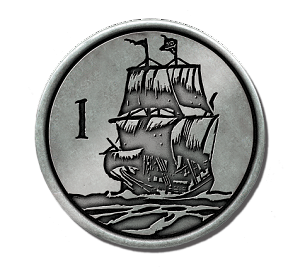
A: It wasn't as simple as just providing a piece of line art. First, in order to achieve the period look, I wanted to try scratchboard. This is a technique where ink is applied to a white, clay-coated surface, and when dry scratched off and shaped to reveal white line. The effect this achieves is that lines tend to be broader, and angular, likening them to wood engravings. This bold look would help the image survive the considerable reduction as well, down to the coin-size they appear at. I'd worked this way in the past, but not for some time. This job seemed to be begging for it.

Q: What were the most difficult parts of the process?

A: The coins are a different kind of medium to apply images to, and this brings considerations when creating the art. The coin producer that Atlas settled on was going to antique the coins, which would darken recessed areas. Atlas also expressed an interest in making a good portion of the coin dark, so they would look less shiny and "new". It came down to understanding that any black left on the art would be recessed and antiqued, any white would be raised and shiny, and the white lines shouldn't be too thin or the die wouldn't hold it long ...

Some images we went back and forth with, adjusting line strength, or trying to reverse the backgrounds to see how different effects would work. There was also a lot of discussion about shadows blending together. Atlas was sensitive to the look I was working towards, and we worked together to create both a "pirate" period look, and one that the coin process could maintain.

The design challenge was two-fold. Ideas had to be communicated very simply, and each design had to allow room in its image to contain a numeral on a solid field. Some designs could be strong and bold: Bomb and Cutlass come to mind. Broadside and Call to Quarters were more complex, both in idea and in execution. Some sketches were simplified, and details were dropped out.

Q: And the box?

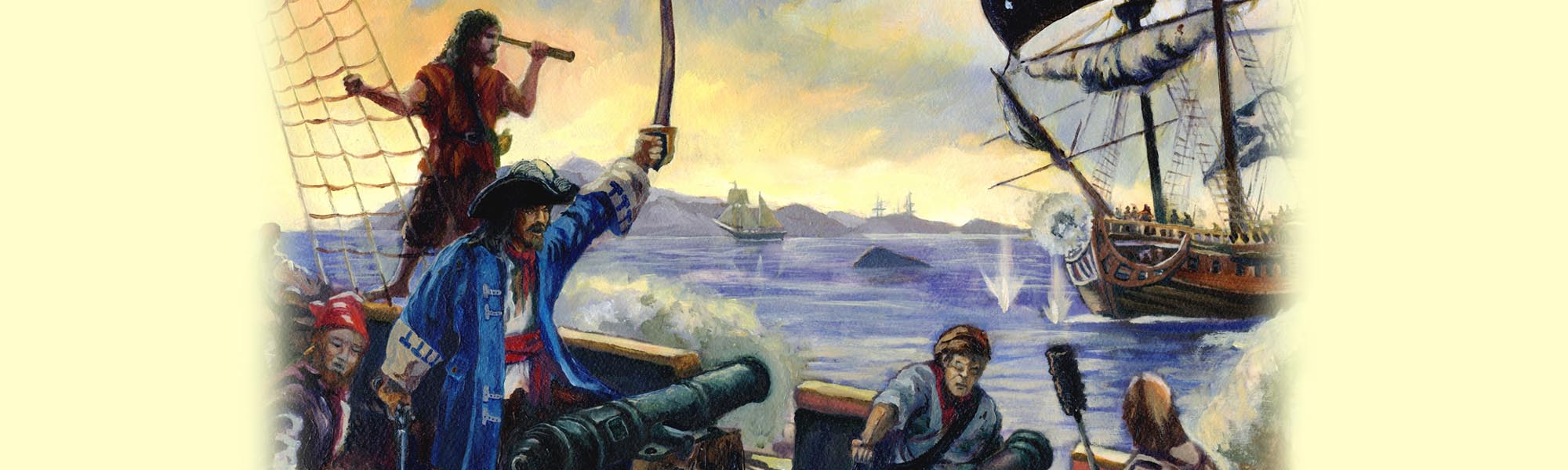
A: The box was another type of challenge. When the decision was made that each ship would have its own box, Atlas presented me this question -- Would it be possible to produce an image that could be cut in half, so that each half could be a piece in itself? In almost 20 years I'd only done one other painting with that kind of idea. It means that the piece has to work as a whole (that would only be seen as an original, or when the boxes are displayed side by side) and also as separate images, each piece with its own focal point. Atlas wanted ships, and sails, but also crew. We played around with layout options, and went with two vertical covers, one primarily a deck scene, and the other mostly about a ship in the distance. The finish has a nice warm look, with lots of cannon smoke and deck action.

Q: What about the logo?

A: The logo was created to have a hand-drawn look, like period calligraphy on parchment. The key element was the integration of coins. When sketching out the words in my sketchbook, I repeated drew out the "g" in "Eight" in an old style, with a closed loop beneath, giving me two circles within the type itself. Transforming them into coins was easy enough, and the strong outline helps retain the shape of what would have been the "g". The images on them are similar to those found on actual pieces-of-eight, or Spanish "reales" of the pirate era.

It was great to be involved in the project early on, and to help shape the look of the product. With the rest of the group that worked on it, I can't wait to see how such a different game design will meet with players' interest. The promo coin meets every expectation, and the feel of the metal in hand adds considerably to the period quality. It just wouldn't be the same with plastic.

Downloads

Get more for your money with these downloads. Links

Link up with other fans! Playtesters

With as many playtesters as helped us with Pieces of Eight, it's not surprising that we missed a few. Our thanks go out to Rich Gains, Jerry Corrick, and Ross Jepson for their help.

For downloads and links relating to a specific product, follow its link in the left bar.

For discussion & rules questions, visit the Atlas Games Forums.